I understand not every decade was a clean break, but each decade has fairly distinct defining properties. It feels like most of the 21st century has been a single run on with smaller changes. I know sometimes the definitions don’t come into focus until later, but I’ve been around since the 80s and I can distinctly remember the changes between the 80s, 90s and 00s as they were happening.
Your impression of those decades is influenced by styling and design.
Photos of actual people on the street show a lost less variation between the 1950s, 60s, and 70s than you might imagine. But when stylists want to cue the era they dial up tropes that are instantly recognizable. Bobby sox and poodle skirts are instantly recognizable as 1950s style, but it probably applied to only a small geographical area in a few urban areas. Similarly the greaser stereotype was not widespread. But now you’d believe that half of high schools were wearing white t-shirts and leather jackets.
I lived through the punk scene. Half the people at the shows I went to look like they were part of a varsity basketball team. We had one friend who had spiked hair and people would cross the street to avoid him. The styling now would have you believe that most young people were decked out in eyeliner and bondage pants.
Tons of reasons.
- You lived through them. There is a continuity in your mind, rather than a dissociated aesthetic.
- Survivorship bias takes time. We think of bell bottoms for the 60’s, even though there were many other pant styles. Over time, specific things become iconic of an era.
- The internet and mass media flattened and accelerated trends.
Also the idea that after The Millennium, we instead focused on categorizing generations more. Which changed how each generations experienced the decades, making them less homogeneous.
I’ve started calling this the 20s every chance I get.
It’s 1996+30.
The 20s this century suck!
They sucked for most people last century also.
deleted by creator
Personally speaking I also lived through the 80’s and the 90’s but if you were to ask me to pick out the differences between the aesthetics from two photographs one from 2007 and one from 2017 I’d be hard pressed. If the images were taken on a consumer grade camera I’d probably focus on the differences in image resolution, but other than that I’d probably be hard pressed.
Now if you were to repeat the experiment with two images from 87 vs 97 oh yeah I’m confident I’d be able to figure out which decade things were from.
What I’m getting at is I’m not sure how much living through the eras really blunts our ability to perceive the differences between decades. If anything when watching period pieces with actors pretending to be in the 80’s or 90’s I feel like I’m acutely aware of the subtle tells that give away this wasn’t actually filmed in the past.
I agree with some of your points. I also lived through the 80’s and 90’s and can pick them out more acutely.
But they’re also long ago enough for the survivorship bias to kick in. There are highly specific aesthetics of the 80’s that are regurgitated back to us through media that says “THIS IS THE 80’S”. Think Stranger Things, where they just condensed an entire decade into head nods. Whether or not we personally experienced some of these things, we collectively accept them as “the 80’s”.
Meanwhile, no one is putting Bow Biters forward as iconic of the era, despite the fact that I remember seeing them everywhere when I was a kid. They are not a culturally recognized touch point the way that acid washed jeans and curly mullets are.
I think the average person has a very strong link to the aesthetics of their childhood, too. Someone born in 1995 is going to have a much sharper sense of what the “2000’s” looked and felt like than you or I.
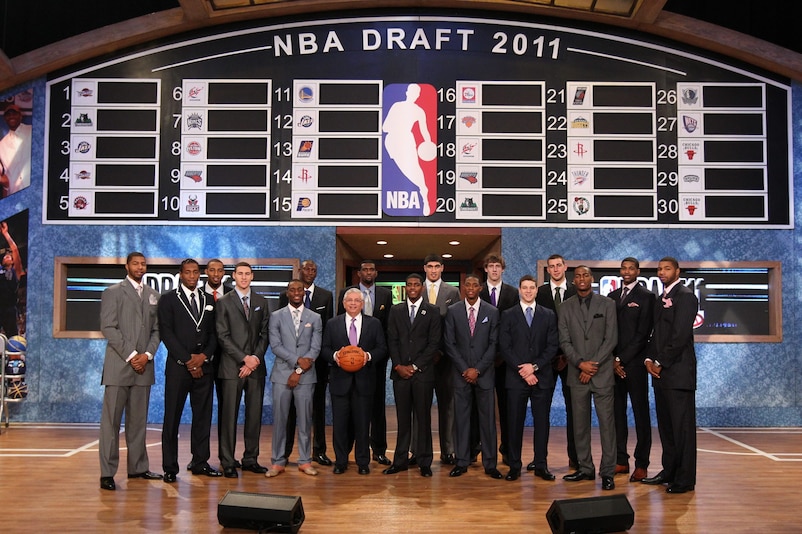
Just looking at how the NBA draft class has dressed for draft day. 2004 is extremely baggy. 2011 is significantly less baggy, and very limited color choices. 2018 everyone is wearing tight fitting clothes and lots of color. By far the biggest variety of clothing choices. 2025 is notably more baggy than 2018, color choices are a bit more limited, but lots of textures.
Hair also seems to have changed significantly from the first two to the second two. A lot more shaved heads and shorter hair in 2004 and 2011, more long hair in 2018 and 2025.
…is this like how the BIG MAC is actually an accurate representation of inflation? Is the NBA draft an accurate representation of decades?
Obviously it’s a limited sample of men’s fashion, but yes I think these overall trends of baggyness and hair length are similar to real life in the USA. These are athletes mostly age 19, up to age 21-22. Getting money for the first time in their lives. If you’re familiar with which ones are foreign, they are sometimes the ones that are 10 years behind on the trend.
Literally zero of these kids were rich before the draft. I think it’s fair to say. Each one is in control of their own hairstyle. Each one got to pick what they wore, even if they asked their agent to pick it out.
EDIT: 2018 is also full of bowties. A trend that has come and gone. In 2025 nearly half are wearing a necklace in place of a tie.
I feel like the 00s and 10s and 20’s all had pretty distinct aesthetics, music, etc as much as the 1900s decades.
20th century saw huge technological change - maybe the greatest of any century - and constant pressure for music and marketing to evolve year upon year. Society was fractured following the fall of the old empires and this allowed people to embrace new political and lifestyle ideologies - everyone was literally becoming more liberated with every passing decade.
In contrast, we’ve been at a bit of a technological plateu since the turn of the 21st cen. (I say blame the lobbyists from oil and gas, but I digress). Marketing and music nowadays is under pressure to conform rather than innovate, so styles are more likely to draw upon their antecedents and contempories than experiment with something new.
You could also interpret it as: after much experimentation, society has settled on a set number of fashion styles and musical styles we all really enjoy - and it’s anchored around the 1980s, which is why thing keep on “looking back on” 80s culture with nostalgia. The things that do change nowadays are digital art styles, AI slop style, and web interface. Somethings just “plateau” for a while - technology in the dark ages, population prior to the industrial revolution, and fashion, from around 400AD to 1500AD.
And one last element - in america, the 20th century saw continuous development of economic well-being, on average, as more and more oil and foreign countries were exploited. This allows people to be creative, and the visible rapid change of society represents the visible flaunting of its’ citizens’ wealth.
The same would not be true for the Soviet Union, for instance; for although it saw major economic stabilisation, communist russia didn’t see a very rapid progression in family wealth, and you can SEE that they have very similar art styles and architecture from the dawn of the century right through to the end - no flaunting of wealth.
Even countries like Britain didn’t get noticably richer from 1945 to 1991 and I’d argue you can definitely see this in our cities, where we’ve been afraid to knock down old buildings where america wouldn’t hesitate. Britain did see dramatic changes in style, in-line with america, but this is expected because it’s a satellite state of the American “empire.” See, our styles and architecture since 1945 have largely not been our own, that is how strongly influenced we are by the big dog USA.
Would also love to hear your own thoughts on the matter, u/ramble81@lemmy.zip, I’m sure you have your own theories
There wasn’t much change either from 700 to 1000 - or at least we don’t know much about it.
I think there are a few different dimensions of this, all combining to blur the view:
- the original Industrial Revolution, the Roman Empire, was kinda steady-state, compared with what we’ve been experiencing…
the probably beginning around Newton cascade of Industrial Revolutions ( in different industries! ) is still accelerating.
Coal+steel+steam was 1 of them.
Telegraph meant information could travel FAST long-distances, then wireless took it farther…
computers began automating things, then began enabling calculations which hadn’t even been possible…
aviation ensmallening the world ( if embiggen is a word, then so is that! : )
but what happens when there are sooo many transformations, CRT’s with their lead-glass to reduce people’s X-Ray exposure, now into flat-panels…
genetic-testing all over the place…
lighting no longer being incandescent…
EV’s all over the place…
it isn’t that change isn’t happening, it is that the equilibriums aren’t happening!
It’s ALL punctuation, continuously-rolling, now!
So, accelerating change, is part of what’s going on…
TWO. the view: we’re IN the maelstrom, & therefore can’t see the forest for the trees!
I recently went into a city, to ( fail ) to get ID, & … everybody was on these weird scooter-ebikes?
When the hell did THAT happen?
I’ve only been out from cities for … 15y?
Obviously, it happened sometime in the intervening 1.5-decades, but … that’s fairly distinct!
So now there’s 2 overlaid public-transport systems: bus-routes covering the arteries of the city, & those rentable-everywhere scooter-ebike thingies, for all the point-to-point travel…
Brilliant!
I wish it’d been in-place decades ago.
THREE. consider that part of what makes distinct decades distinct, is identity … & consider that in the current world, dividing-and-conquering everybody by identity, through software-enforcement ( Facebook, etc ) is making much of our world invisible, physically: it’s ONLY in those platforms.
So, it isn’t even in your, or my, view, to be seeing what the world really is, anymore!
Concealment ( for divide-and-conquer purposes ) is growing more ideology-polarization.
Don’t worry: it’ll be as clear as Russia-vs-Ukraina, in a short while, globally…
_ /\ _
I mean an obvious break in the decades was covid. There has been a fair amount of shift in a lot of different things pre/post covid that maybe doesn’t stick out due to the gradual shift, but will definitely be more apparent to anyone looking back on the 2010-2030 time period.
I suspect because you haven’t had any major milestones this century. I graduated undergrad and 93 joined the army, met my wife and son. I got out of the army in 2000, A few years later, I adopted my son, A next major milestone was when he first went to first grade then when he went to middle school, then when he graduated high school school. I got a great job in 2000. I got an even better job in 2002. I got an even better job in 2006 and then I got a Phenomenal job in 2010. Lots of major milestones to break up the early parts of the century. Then I had similar major milestones between 2010 and 2020 and 2020 was the pandemic and blah blah blah blah blah
yeah its like everything kind of stagnated with the iphone. I mean the 70’s there was barely any electronics and then the 80’s had all kinds of things and by 90’s doing things by hand basically went away and in the aughts printing things out basically died out. I mean we have thigs advancing sorta but in ways I don’t like. Like everything becoming and app and everything connecting to the internet and now getting ai integration.
To counter that, the open source scene is bigger than it’s ever been and is potentially on track to start making waves in the mass market. That’s a big thing that I feel was not the case in the 2010s. There’s way more DIY going on in the 2020s I feel. So not all bad at least.
Ill agree here. enshitification is moving folks toward open source and specifically libre and making them more willing to just abandon technology all together.
There’s way more DIY going on in the 2020s I feel.
Yeah, because nobody can afford to have quality craftsmanship these last 3 decades. So now people are like “FINE! I’LL DO IT MYSELF!”
I think there’s a bit of that, but also a bit of… unsubtle enshittification. I mean the obvious, AI features that nobody likes getting crammed into everything. Apples Intelligence making siri unable to do simple tasks it used to be able to do easily.
A lot of people would be happy to pay premium price for things that do exactly what they want. But more and more software companies are reversing what they do… and even when they do what you want, you still have to be vigilant on them changing their minds and removing features, or adding subscription costs etc…
If you live in the US, George W. Bush went to war in Afghanistan in October 2001 and war in Iraq in February 2003 and Donald Trump arranged the surrender/withdrawal from Afghanistan on Feb 29th, 2020, ending the war exactly as the COVID-19 pandemic was ramping up. Then in January 2021 there was a coup attempt just as the first COVID-19 vaccines were becoming available for essential workers outside healthcare.
Buildings have become significantly more expensive to build, so only rich people build them in planned formats to make as much money as possible. Back in the day, regular people could build their own properties or afford to renovate according to their taste.
I think this is certainly one important element to it!
And when I think of America, I actually can see distinctions in 2020 / 2010s architecture compared to 2000s or earlier - America can afford to build where Britain and other european countries can’t, really. Or won’t, because of environmental reasons and lower population growth.